

YOU MAY ALSO LIKE


The air in Lincoln County, New Mexico, on the night of July 2, 1947, was thick with the electric charge of a violent summer thunderstorm. Lightning ripped across the black desert sky, illuminating the stark, dusty landscape of the Foster ranch. But amid the natural fury of the storm, ranch foreman Mac Brazel heard something that made him freeze—a sharp, echoing crack that sounded entirely different from the rolling thunder. It was a sound of tearing metal, a violent rupture in the sky that vibrated right through the floorboards of his quiet ranch house.
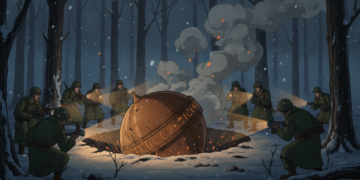
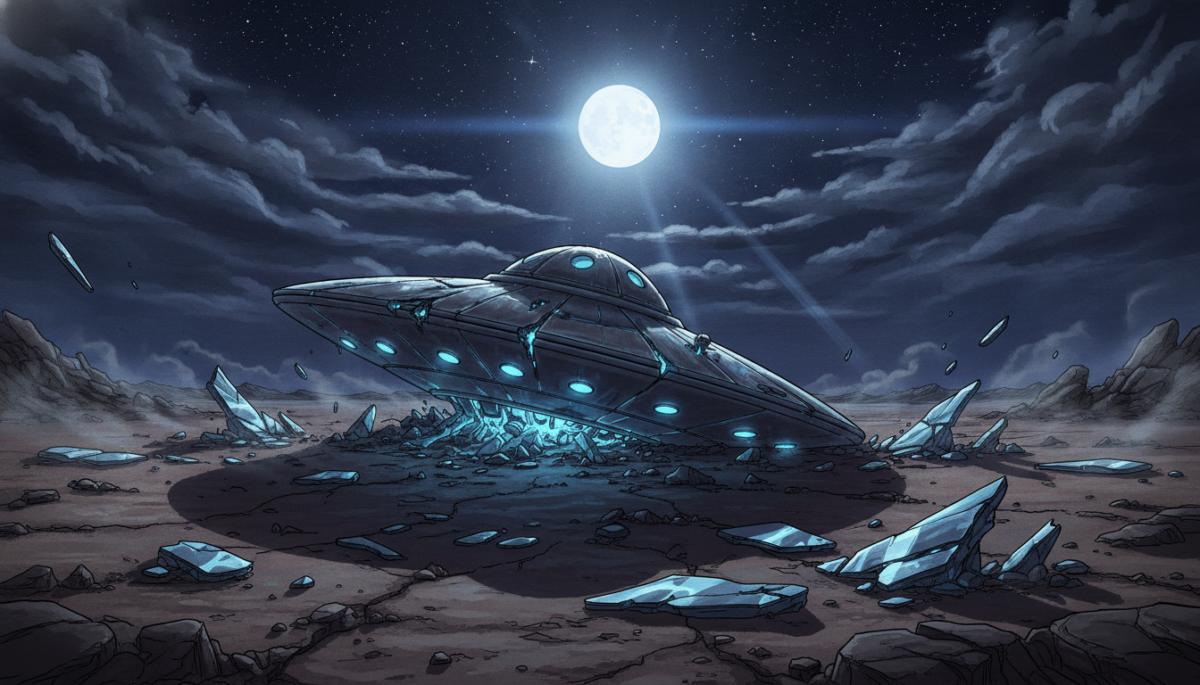
The next morning, under a blindingly blue desert sun, Brazel rode out to check on his sheep. What he stumbled upon in a remote pasture was not the usual debris of a storm, but a scar on the earth. Scattered across a strip of land nearly a mile long was a vast field of glittering, unfamiliar wreckage. There were no heavy engines, no fuel tanks, and no wires. Instead, the ground was littered with light, parchment-like foil, structural beams marked with faint, purple-pink symbols, and tough, thread-like fibers that seemed to glow in the harsh daylight.
The Metal That Remembered
Kneeling in the dirt, Brazel picked up a piece of the silvery foil. It felt weightless, almost like liquid silk in his hands. He crumpled it tightly in his fist, expecting it to crack or stay folded like tin foil. Instead, when he opened his hand, the material smoothly unfolded itself, returning to its perfectly flat, unwrinkled state. It was a physical impossibility—a metal with a memory. “You couldn’t crease it, you couldn’t burn it, and even a pocketknife wouldn’t leave a scratch,” Brazel would later recount to his neighbors, his voice trembling with a mixture of awe and fear.
Perplexed, Brazel loaded a box of the debris into his truck and drove to the nearby town of Roswell, handing it over to Sheriff George Wilcox. Wilcox immediately contacted the Roswell Army Air Field (RAAF). Within hours, Major Jesse Marcel, an intelligence officer, was dispatched to the ranch. Marcel, an experienced military man who knew every aircraft in the sky, was astounded. He knew instantly that this material did not originate from any earthly machine. On July 8, 1947, public information officer Walter Haut released a press statement that shook the world: the military had recovered a “flying disc” from a ranch near Roswell.
The Great Erasure
The truth, however, was quickly silenced. Within hours of the announcement, the Pentagon intervened. General Roger Ramey ordered Marcel to fly the debris to Fort Worth, Texas. There, in Ramey’s office, the real wreckage was whisked away, replaced by the shredded remains of a common weather balloon and a tinfoil radar target. Photographers were ushered in to capture Marcel looking sheepish next to the cheap, wooden sticks and rubber. The headline was rewritten overnight: it was all a misunderstanding.
But the men who touched the real debris knew better. Decades later, Jesse Marcel would break his silence, admitting that the weather balloon story was a complete fabrication designed to protect the most explosive secret in human history. “It was not of this earth,” Marcel stated firmly in his later years. The military had seized everything, threatening locals and enforcing a strict code of silence that blanketed the New Mexico desert like a heavy shroud.
Whispers from the Autopsy Room
The cover-up extended far beyond mere metal and foil. Deep within the heavily guarded hangars of the Roswell airfield, a far more chilling discovery was allegedly taking place. Local mortician Glenn Dennis received a series of strange phone calls from the base inquiry officer, asking about the availability of small, hermetically sealed coffins and how to preserve bodies that had been exposed to the elements for days.
Later, a young military nurse, visibly shaken and trembling, met Dennis in secret. She described a scene of pure nightmare: three small, non-human bodies had been recovered from a second crash site nearby. They were fragile, four feet tall, with oversized pear-shaped heads, large dark eyes, and only four fingers on each hand. She sketched the entities on a paper napkin, crying as she described the unbearable stench of the autopsy room. Shortly after their meeting, the nurse was abruptly transferred to England, her records vanished, and she was never heard from again.
The Eternal Desert Wind
Today, the official narrative remains locked behind decades of classified files and redacted documents, but the whispers of July 1947 refuse to die. The Roswell crash was not a weather balloon; it was the moment humanity’s isolation in the cosmos was shattered, only to be immediately swept under the rug of national security. When we look at the night sky, we are reminded that some secrets are too vast to remain buried forever.
Out in the quiet New Mexico desert, far from the neon signs of the museum gift shops, the wind still sweeps through the scrub brush of the Foster ranch. If you stand in that empty field under a canopy of cold, brilliant stars, the silence feels heavy, pregnant with the memory of a night when the heavens fell to earth, leaving behind a truth that still waits in the dark.
Frequently Asked Questions
Why did Mac Brazel think the debris found on his ranch was not from a standard aircraft or weather balloon?
Brazel noticed the debris lacked common aircraft components like heavy engines, fuel tanks, or wires. Instead, he found weightless, silk-like silver foil that instantly unfolded itself when crumpled, resisted burning, and could not be scratched even with a pocketknife, indicating properties unknown to conventional technology of the era.
How did the military manage to quickly change the public narrative after announcing they recovered a flying disc?
The Pentagon intervened hours after the announcement. General Roger Ramey ordered the real wreckage to be flown to Fort Worth, where it was replaced with shredded remains of a weather balloon and a radar target. The military then forced a photo opportunity with the fake debris to rewrite the headlines as a misunderstanding.
What evidence suggests that the Roswell crash involved more than just recovered physical debris?
The involvement of biological remains is suggested by local mortician Glenn Dennis, who received inquiries from the military base about small, hermetically sealed coffins and body preservation. Additionally, a military nurse privately described witnessing three small, non-human bodies that had been recovered from a second crash site.
What did intelligence officer Jesse Marcel reveal later in life about the Roswell incident?
Decades after the event, Jesse Marcel broke his silence to admit that the weather balloon explanation was a complete fabrication forced by the military. He firmly maintained that the actual debris he recovered from the Foster ranch was not of this earth and differed entirely from the items shown in the press photos.
Discover more from Nenext
Subscribe to get the latest posts sent to your email.