

YOU MAY ALSO LIKE


Come closer, little one. Pull your skin-wrap tight against the creeping mountain chill and listen. Do not look at the shadows dancing on the cave wall; look at me. My eyes are cloudy now, like the river after a heavy rain, and my joints pop like dry twigs in the hearth. I am the last who remembers the words of the first grandmothers. When my chest grows still and my breath returns to the great wind, this story will go with me—unless you hold it. Listen with your skin, not just your ears.
Before there was dry dirt to walk upon, there was only the endless, gray water. It rolled and murmured under a sky that had no sun, only a cold, perpetual mist that clung to the throat. Above that mist, in the high spaces where the air is pure and sweet, lived the Orishas. But Obatala, the great shaper, grew tired of looking down at nothing but his own reflection in the silent deep. He wished for something solid, something that could grow, something that could look up at the heavens and speak.
The Descent on the Golden Link
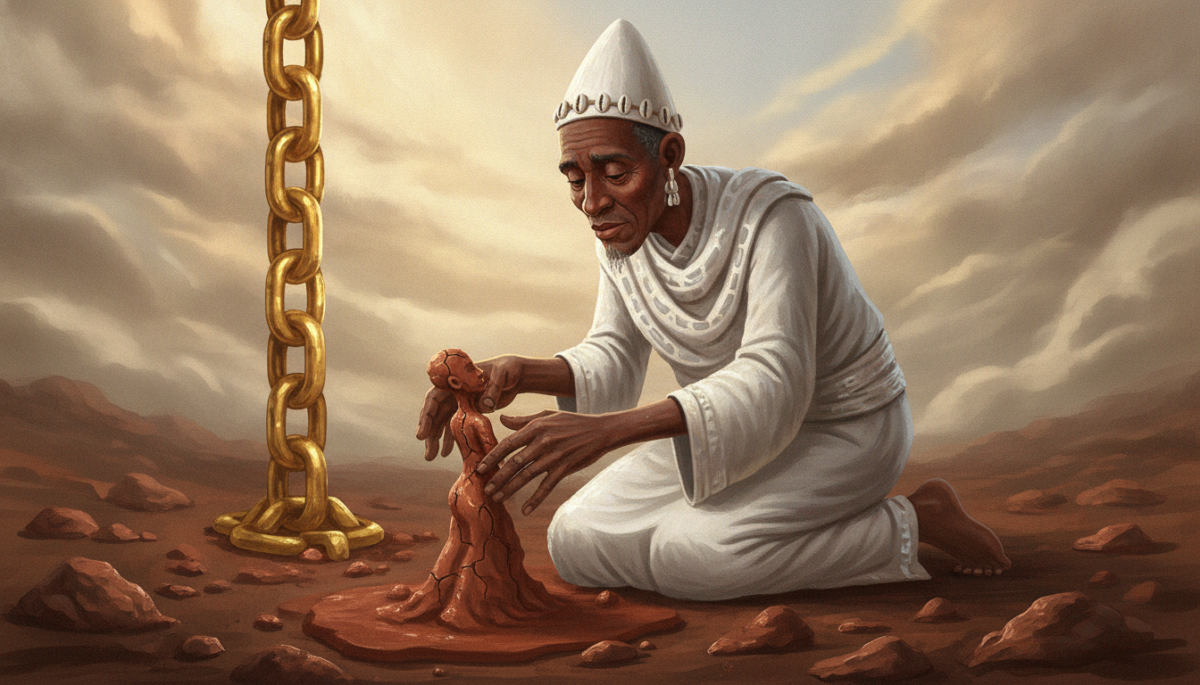
I can feel the cold metal in my palm even now, though I have never touched it. To descend into the great wet void, Obatala needed a path. He went to the goldsmith of the heavens and melted down all the gold of the divine ones—every collar, every ring, every heavy bar. From this, they forged a chain. It was not a delicate thing; it was thick, heavy, each link as wide as a man’s thigh, cold and gleaming with the raw light of the upper world.
Obatala slung a bag of dark, dry earth over his shoulder, tucked a five-toed hen into his sash, and began his descent. Link by link, he lowered himself into the gray fog. Imagine the silence of that descent, child. No birds, no wind, only the rhythmic clink-clink of gold against gold, and the biting chill of the mist rising to meet him. His hands grew raw and slick with the condensation of the clouds. When he reached the very last link, his feet dangled in the empty air, inches above the black, bottomless water. He could go no further. From his bag, he scattered the dry earth upon the waves, and he set the five-toed hen upon it. With her claws, the hen scratched and scattered the dirt, spreading it wide until it pushed back the waters and became the solid ground of Ife.
Kneading the Primeval Mud
Obatala stepped down onto the new earth. It was wet, heavy, and smelled of the deep, ancient dark. It was a lonely place, still and silent, waiting for a voice. He sat by the edge of the water where the dry land met the tide, and he began to dig his fingers into the mud. This was not the clean, dry sand of the dunes, but thick, sticky clay, rich with the rot of the old world.
With his great, patient hands, he began to shape them. He rolled the clay between his palms, smoothing the rough edges, pulling out arms and legs, pressing his thumbs into the wet mounds to create eyes that could see and chests that could hold air. The clay was cold and stubborn. It clung to his skin, drying in gray crusts on his knuckles. He made them in our image—some tall and straight like the ironwood trees, others curved like the river banks. He spent days in the mud, his back aching under the weight of his creation, his fingers cracked and bleeding from the grit of the earth. He loved them before they even had names.
The Breath of Olodumare
But they were only clay, cold and stiffening in the damp air of Ife. They lay in rows along the shore, hundreds of pale, silent dolls, their empty eyes staring up at the gray sky. Obatala could shape the hands, he could carve the lips, but he could not give them the spark that makes a man stand. He could not make them warm.
Then came the shadow of Olodumare, the Supreme One, the Owner of the Sky. He did not descend on a chain; he came like a sudden shift in the wind, a pressure that made the ears pop and the heart beat faster in the chest. Olodumare looked down at the silent clay figures lying in the mud. He saw Obatala’s tired shoulders, his hands caked in dry earth, his silent plea. The Supreme One leaned down. The wind stopped. The waters grew still as stone.
With a sound like the first sigh of a winter forest, Olodumare blew his breath—the emi—across the rows of clay. It was a hot, rushing wind that smelled of lightning and dry grass. When that breath touched the cold clay, a miracle happened that makes my old bones tremble to speak of. The gray mud turned to dark, pulsing flesh. The stiff limbs softened. And then, child, came the sound—the sudden, sharp, collective gasp of a thousand lungs tasting the air for the very first time. It was a wet, rattling shock of life, the sound of clay tearing itself away from the earth to become spirit.
The Fire Whispers
Look at your hands, little one. Press your fingers into the dirt beside you. Feel how it is cold, how it clings to your skin? That is the clay of Ife. Now, press your hand against your chest. Feel that steady rise and fall? That is the breath of Olodumare, still warm, still moving through the vessel that Obatala shaped so long ago.
The fire is burning low now, and the ash is swallowing the red embers. My voice is tired, and my breath wants to join the wind outside the cave. But you have heard. The memory is no longer mine alone. It lives in your blood now. Keep the clay wet, child. Keep the breath moving. Never forget where the first step was taken.
Frequently Asked Questions
Why did Obatala decide to use a golden chain instead of another material to descend to Earth?
The golden chain was forged from all the gold of the Orishas, including collars, rings, and bars. Gold was chosen because it was the only divine material strong and heavy enough to create a physical path from the high, pure spaces of the heavens down into the cold, bottomless gray void of Earth.
What was the specific role of the five-toed hen in the creation of Ife?
The five-toed hen was crucial for creating dry land. After Obatala scattered a bag of dark, dry earth onto the endless waters from the end of the golden chain, the hen scratched and scattered the dirt with her claws, spreading it wide enough to push back the waves and form the solid ground of Ife.
Why was Obatala unable to complete the creation of humans on his own?
Although Obatala possessed the divine artistry to mold the clay into detailed human shapes with eyes, limbs, and chests, he lacked the power to give them life. The figures remained cold, stiff, and silent dolls until the Supreme One, Olodumare, arrived to breathe the vital spark of life into them.
What does the physical state of the clay used by Obatala reveal about the nature of early Earth?
The clay was not clean sand but thick, sticky mud rich with the rot of the old world, smelling of the deep, ancient dark. This reveals that the early Earth, before human life, was a raw, primordial, and wild environment that required Obatala's intense, physically demanding labor to shape.
Discover more from Nenext
Subscribe to get the latest posts sent to your email.