

YOU MAY ALSO LIKE


Lean closer, child. The embers are losing their red teeth, and the cold from the desert is crawling back into our bones. Do not look at the shadows dancing on the tent walls; look at my hands. See how the skin is split like dry riverbeds? My eyes are dim, and my lungs drag like heavy sacks, but my memory remains clear as the first well. I am the last who remembers the song of the wheel. Before the sand swallows my voice, you must take this weight from me. You must know where your blood was brewed.
Before there were kings with golden crowns, before even the stone tombs were cut into the cliffs, there was only the Great Wetness. The Nile was not a river then; it was a wild, dark beast that roared through the black silence. Every year, it tore open the earth and left behind a thick, heavy mud that smelled of rotting reeds and cold, deep secrets. It was a time of cold morning mists that clung to the reeds like wet wool. And there, where the river splits at the first cataract, sat the Great Spinner.
The Great Spinner at the River’s Edge
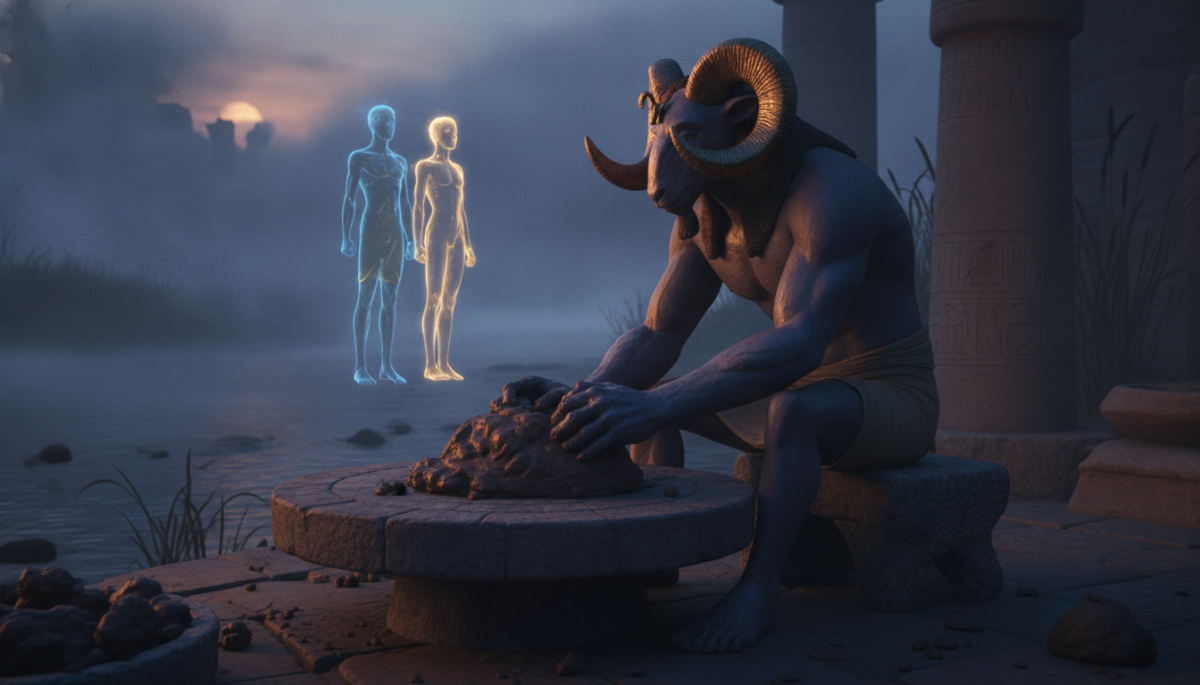
He was not like us, yet he was the father of our bones. He had the body of a man, broad as an acacia trunk, but his head was that of a ram, with horns that curved like the crescent moon. His name was Khnum. I can still hear the wet, rhythmic slap-slap of his hands against the clay, echoing through the empty canyons. He sat upon a stool of basalt, his great knees parted, and before him revolved a heavy stone wheel. It turned not by wind or water, but by the slow, deliberate pulse of his own divine foot.
He did not pull his clay from just anywhere. He reached deep into the belly of the inundation, scooping up the dark, fat silt that Hapy brought from the south. It was cold, slippery, and alive with the hunger of the earth. I want you to imagine that mud, child. It was not dirt; it was the very flesh of the land, thick with the seeds of things yet unborn. Khnum would take a lump of this black grease, throw it onto the center of his spinning stone, and begin to work.
Shaping the Clay and the Double
His fingers were thick, but they moved with the gentleness of a moth’s wing. “Watch,” he would whisper to the empty air, and the wind would die down to listen. With his palms, he pressed the spinning lump, flattening it, then pulling it upward into a hollow cone. From that wet tower of mud, his thumbs pinched out the shape of a leg, the curve of a rib, the delicate hollow behind the collarbone where a mother’s tears gather. He molded the vessel of the body, choosing the thickness of the skin and the strength of the thighbones that would one day walk these deserts.
But a vessel of clay is only a jar until it is filled. As his left hand shaped the outer skin of the man, his right hand worked the air just inches beside it. This was the mystery that our people have forgotten. He was not just making one shape; he was making two. Out of the same damp earth and the same spinning motion, he molded the ka—the double, the shadow-twin that breathes when we sleep and guides us through the dark valleys of the afterlife. The ka was the fire to the clay’s wood. Without it, the body would just be a cold lump for the jackals to sniff.
The Breath of Life and the Final Spark
I remember the story my grandfather told me, under a sky just as dark as this one. He said that when Khnum finished a child, the clay was still wet, shining under the pale sun of the first morning. The god would lean down, his ram’s breath smelling of sweet river grass and crushed barley. He would hold the tiny clay nostrils to his own and blow. “Receive,” he would rumble, a sound that shook the bedrock beneath the river. And with that breath, the wet clay hardened into warm flesh, the blue veins began to throb beneath the skin, and the ka slipped inside the chest like a bird returning to its nest.
That first breath, child, was a sudden, sharp shock. It tasted of salt and river silt. The first human cried out, not from sadness, but because the spirit was suddenly bound to the heavy earth. We are all of us made of that same river mud, shaped by those same heavy, ram-headed hands. Every bone in your body was measured on that stone wheel. Every beat of your heart is just the echo of Khnum’s foot driving the stone round and round.
The Legacy in the Dust
Now, the campfire is nearly dead. Only the gray ash remains, cold and soft like the dust we will all become. I give this memory to you. When I am gone, and they ask you who you are, do not tell them you are a creature of the dust. Tell them you are the clay of the Nile, shaped by the Great Spinner, carrying a twin of pure light within your chest. Guard this truth as you would guard the last drop of water in the dry season. Let the wheel keep turning in your mind, and never forget the smell of the wet earth from which we rose.
Frequently Asked Questions
Why did Khnum specifically use the mud from the Nile's first cataract for his creations?
The mud from the first cataract was not ordinary dirt, but a rich, dark silt brought from the south by the river god Hapy during the annual inundation. This clay was believed to be the very flesh of the land, cold, slippery, and alive with the primal hunger and creative energy of the earth, making it the perfect medium for molding human life.
What is the significance of Khnum creating two shapes simultaneously on his wheel?
Khnum did not just mold the physical body; he simultaneously shaped its 'ka' or shadow-twin. While his left hand formed the physical vessel from the clay, his right hand worked the air to create the spiritual double. This ka acted as the life force and guide, serving as the essential fire that animated the cold clay body.
How did the molded clay figures of Khnum transition from lifeless mud into living human beings?
The transition occurred through a divine breath. Once the clay figure and its ka were molded, Khnum would lean down and blow his ram's breath, smelling of sweet river grass, into the clay nostrils. This divine breath instantly hardened the wet mud into warm flesh, started the pulse in the veins, and housed the ka within the chest.
What does the physical appearance of the god Khnum symbolize in the creation myth?
Khnum is depicted with the broad body of a man and the head of a ram with horns curved like the crescent moon. His human body represents his role as the father of human bones and physical structure, while his ram head and crescent horns symbolize fertility, leadership, and the cyclical, generative power of the Nile's waters.
Discover more from Nenext
Subscribe to get the latest posts sent to your email.