

YOU MAY ALSO LIKE


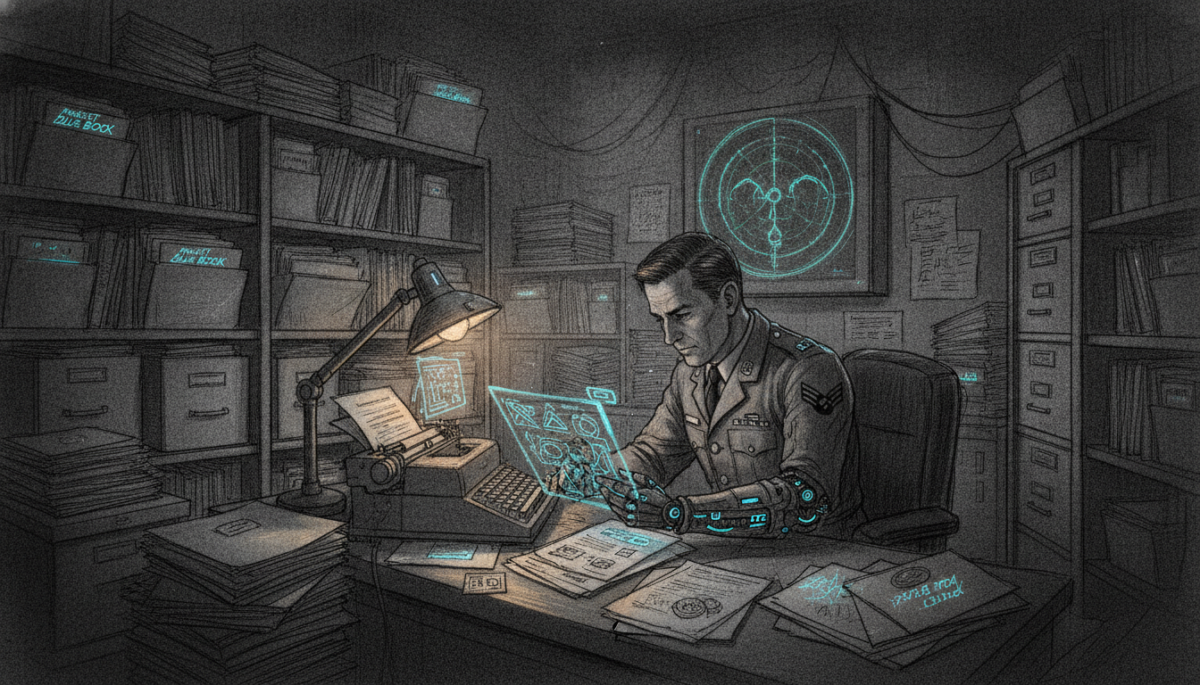
On a humid summer night in 1969, somewhere behind the quiet, fluorescent hum of an Air Force office, a cardboard box was slid onto a table and opened for the last time. Inside were memos, photographs, witness statements, radar printouts, and handwritten notes about lights in the sky that had frightened pilots, confused scientists, and kept military officers awake long after midnight. If you were standing there, peering into that box, you might have asked the same question that haunted the project for nearly two decades: what happens when the government tries to explain the unexplainable, and still comes up short?
The First Files Open
Project Blue Book began not as a grand mystery, but as a practical response to a very modern kind of panic. In the early 1950s, the United States Air Force was receiving a flood of reports about unidentified flying objects. The Cold War had made the sky feel thinner, more dangerous. Every strange light could be a secret Soviet aircraft, an atmospheric illusion, or something no one wanted to name out loud. So the Air Force created an official investigation, hoping to separate fantasy from fact.
At Wright-Patterson Air Force Base in Ohio, the work was part detective story, part bureaucracy. Witnesses described brilliant discs hovering over fields, silent formations racing across the dark, and objects that seemed to vanish the moment anyone trained binoculars on them. One clerk might stamp a report
Frequently Asked Questions
Why did the Air Force create Project Blue Book instead of just ignoring UFO reports?
The Air Force saw the reports as both a public concern and a potential security issue. In the early Cold War, unknown objects could have been Soviet aircraft, weather effects, or misunderstandings. Blue Book gave the military a formal way to sort credible sightings from noise, reduce panic, and determine whether any cases posed a real threat.
Did Project Blue Book only investigate eyewitness accounts, or did it use technical evidence too?
It used more than eyewitness accounts. Investigators collected radar readings, photographs, pilot logs, meteorological data, and written statements. The goal was to compare human testimony with physical evidence whenever possible, although many cases still ended up with incomplete data or conflicting interpretations, which made definitive conclusions difficult.
Why were so many UFO sightings hard to resolve even with military resources?
Many sightings happened in seconds, under poor lighting, and from moving aircraft or ground positions that distorted distance and speed. Weather, reflections, astronomical objects, and camera limitations could all create convincing but misleading evidence. Even trained observers often described the same event differently, which made it difficult to verify what actually occurred.
Was Project Blue Book meant to prove UFOs were real?
No. Its purpose was to determine whether any sighting represented a threat to national security or had a mundane explanation. While the project documented many unexplained cases, it was not designed to confirm alien visitation. In practice, most reports were explained as ordinary objects or natural phenomena, though some remained unresolved.
What happened to the files when Project Blue Book ended?
When the project was closed in 1969, its records were boxed up and archived rather than destroyed. That made the documents available for later review by researchers, historians, and curiosity seekers. The files became important because they preserved firsthand accounts, official assessments, and the government’s own struggle to classify unexplained incidents.
Discover more from Nenext
Subscribe to get the latest posts sent to your email.