

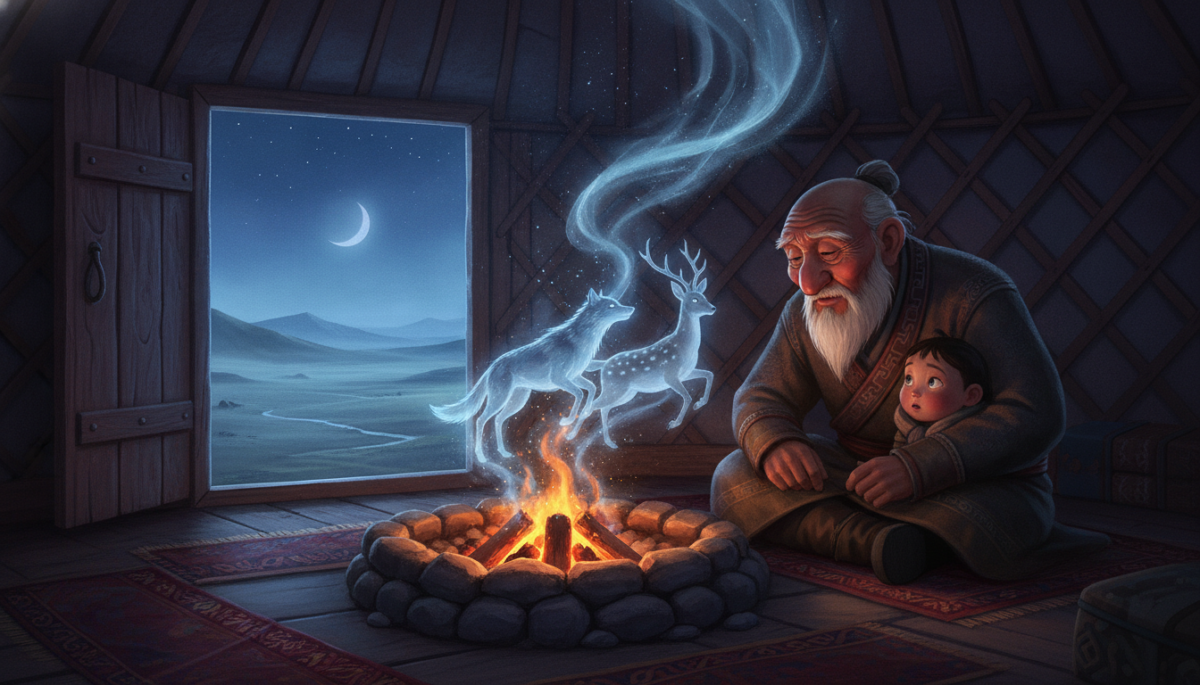


Lean closer, little one. Do not look at the shadows dancing on the felt walls of our tent; look into my eyes, where the last embers of our people’s memory still burn. My hands are like the cracked clay of the dry riverbeds, and my breath smells of the bitter wormwood of the steppe. I am the last who remembers the words as they were first spoken, before the iron of foreign empires trampled our pastures and silenced our songs. If I do not give you this truth tonight, it will vanish into the howling wind like the smoke from our dying hearth.
Feel the cold seep through the ground beneath us. It is the same chill that hung over the primeval world when the earth was young and unnamed. Before the great kings, before the horse-tail banners split the sky, there was only the vast, silent grass and the great blue emptiness above. It is from that emptiness that our blood began.
The Beasts of High Heaven
In the time before time, High Heaven—the eternal blue sky we call Tengri—looked down upon the silent earth. The sky was lonely for a voice that could sing its wildness, and the earth was lonely for a spirit that could run with its winds. To answer this longing, Tengri sent down two spirits clothed in the flesh of the wild. The first was Borte Chino, the Blue-Gray Wolf, born of the sky’s own cold light. His fur was the color of a winter storm, and his eyes held the sharp, unforgiving clarity of stars shining on ice.
Beside him ran Gua Maral, the Fallow Deer. She was born of the earth’s gentle breath, her coat the color of sun-dried grass, spotted like the dappled shadows of the birch forests. She was grace itself, moving over the sharp stones without leaving a sound, her heart beating with the quiet patience of the soil. They were opposites—the predator of the sky and the prey of the earth—yet they were bound by a sacred decree. They were sent to become one flesh, to sow the seed of a nation that would one day shake the foundations of the world.
The Crossing of the Tenggis
The wolf and the deer ran together, driven by a quiet urgency they could not name. Their journey brought them to the shores of the Tenggis, a vast, inland sea whose waters were dark as obsidian and cold enough to freeze the blood in a man’s veins. There were no boats, no bridges, only the endless expanse of grey waves thrashing against the wet mud of the shore.
I want you to feel this, child: imagine the wetness of that primeval mud squelching between your toes, the biting wind spraying cold foam against your face. The deer hesitated, her delicate hooves slipping on the slick, frozen clay. But the wolf did not falter. He stepped into the freezing black water, his thick fur matting with ice, his eyes fixed on the distant shore. Guided by his fierce will, the deer followed. They swam through the dark currents, their breaths coming in ragged, steaming gasps, until they dragged their shivering bodies onto the sacred earth of the opposite shore.
They had crossed the boundary between the spirit world and the physical earth. They had arrived at the foot of Mount Burkhan Khaldun, the sacred mountain where the three rivers—the Onon, the Kherlen, and the Tuul—find their birth. Here, in the shadow of the ancient pines, they made their home.
The First Human Breath
It was on the slopes of Burkhan Khaldun, amidst the damp smell of pine needles and the cold morning mist, that their union bore fruit. Their child was not born with fur or hooves, but with the smooth skin of a human. They named him Batachikhan.
Picture that first moment, little one. The infant lay on a bed of dry moss, shivering in the mountain air. Then came the sudden, sharp shock of his first human breath—a gasp that filled his lungs with the scent of wild birch and wet earth. In that single breath, the wild, untamed spirit of the wolf and the gentle, enduring soul of the deer became human. The blood that flowed through his veins was a mixture of sky-fire and earth-water. He was the first of our ancestors, the root from which all Mongols grow.
This is why we are who we are. When you look at our people, you see the wolf in our warriors—their fierce loyalty to the pack, their silent patience before the strike, their ability to survive in the harshest winters. But you also see the deer in our mothers and our elders—the quiet endurance, the deep connection to the pastures, the gentle care for the young and the weak. We are not merely men of the grass; we are the children of the celestial union.
The fire is dead now, child. Only the grey ash remains, cold and silent. But do not fear the dark. Walk out of the tent with me. Look up at the eternal blue sky, even now dark and filled with stars. Listen to the wind howling through the valley. It is the voice of Borte Chino, calling to his children. Never forget the blood that runs in your veins. You are the son of the wolf and the deer, and the sky will always recognize its own.
Frequently Asked Questions
How does the legend of Borte Chino and Gua Maral explain the dual nature of the Mongol people?
The legend portrays the Mongols as descendants of opposites: the Blue-Gray Wolf, representing the sky's cold light and fierce, predatory will, and the Fallow Deer, representing the earth's gentle, enduring patience. This celestial union of predator and prey explains the balance of fierce strength and deep connection to nature within the Mongol spirit.
What is the spiritual significance of the crossing of the Tenggis sea in the ancestral journey?
The crossing of the Tenggis was not just a physical journey but a transition between realms. By braving the freezing, dark waters, the wolf and the deer crossed the boundary separating the spirit world from the physical earth, allowing them to reach the sacred ground where humanity could begin.
Why is Mount Burkhan Khaldun central to the origin story of the Mongols?
Mount Burkhan Khaldun is the sacred site where the three major rivers—the Onon, Kherlen, and Tuul—are born. It served as the sanctuary where the celestial beasts settled, making it the physical birthplace of Batachikhan, the first human ancestor, and the spiritual anchor of the Mongol nation.
Who was Batachikhan, and what does his birth symbolize in the narrative?
Batachikhan was the human child born to the wolf Borte Chino and the deer Gua Maral. His birth on the slopes of Burkhan Khaldun symbolizes the transformation of wild, celestial spirits into human form, blending sky-fire and earth-water into the very first Mongol ancestor.
Discover more from Nenext
Subscribe to get the latest posts sent to your email.