



Gather closer, little one. Lean your ear near to my mouth, for my chest grows heavy and the wind outside the cave is hungry tonight. Do you see these embers? They are like my eyes—mostly gray ash, with only a tiny, stubborn spark of red left deep inside. I am the last who remembers the taste of the first mud. When I go, the path back to the beginning will close forever, swallowed by the shifting sands. Listen. Do not look at the shadows dancing on the stone wall; look at my hands, cracked like the dry mesas we walk upon. I will tell you how we came to be here, in this cold, vast Fourth World, before the memory turns to dust.
The Rotting of the Third World
Before we walked beneath the hot, bright eye of the sun, we lived down in the dark. It was the Third World, a place that started beautiful but grew wet, heavy, and rotten with our own foolishness. We forgot the song of the Creator. We built great cities of mud and stone, but our hearts grew cold and sharp like obsidian. We used our sacred power to hurt one another, and the air became thick with lies. The waters began to rise from the deep places, smelling of dead fish and stagnant moss. The ground beneath our feet wept black slime. In that choking dark, we cried out. We did not deserve to be saved, but the Grandmother, Spider Woman—whom we call Kokyangwuti—heard the small, clean voices of the few who still remembered how to pray. She came to us, her many legs moving silently through the damp shadows, weaving a thread of hope in the dark.
The Reed That Pierced the Sky
I still remember her voice, little one. It was not a loud thunder that shakes the mountains, but the dry, gentle rustle of autumn grass in the wind. She did not carry us on her back. No, she taught us that salvation requires our own sweat and blood. She planted a great, hollow reed, a reed that grew up and up, piercing through the thick, stony ceiling of our dark world. We had to leave everything behind—our heavy clay pots, our woven blankets, our pride, and our anger. I remember the cold sweat on my palms as I gripped the rough, ribbed stalk of the reed. My knuckles bled against the coarse fibers as we climbed in absolute darkness. Below us, the old world drowned in its own filth, the gurgling of the rising waters chasing us like a great, blind beast snapping at our heels. If you let go, you fell into the black void. We climbed for cycles we could not count, guided only by the faint, rhythmic tapping of Spider Woman—a sound like a beating heart echoing through the hollow reed.
The Birth Canal of the Earth
Then, we reached the Sipapu. It was a small, tight opening, no wider than a man—a crack in the stone weeping with the wetness of the earth’s deep womb. Spider Woman waited there, her ancient eyes reflecting the faint, strange light from above. “Crawl,” she whispered, and her breath smelled of dry sage and ancient dust. “Leave your skin of clay behind. Enter the new world naked and small.” We crawled on our bellies through the narrow throat of stone. The wet mud scraped our chests; the cold, damp rock squeezed the breath from our lungs until we thought we would die in the dark grip of the earth. It was a physical tearing, a painful shedding of who we once were. We struggled, gasping for air that was not yet there, pushing through the primeval clay that clung to our skin like wet shroud-cloth.
The First Breath of the Fourth World
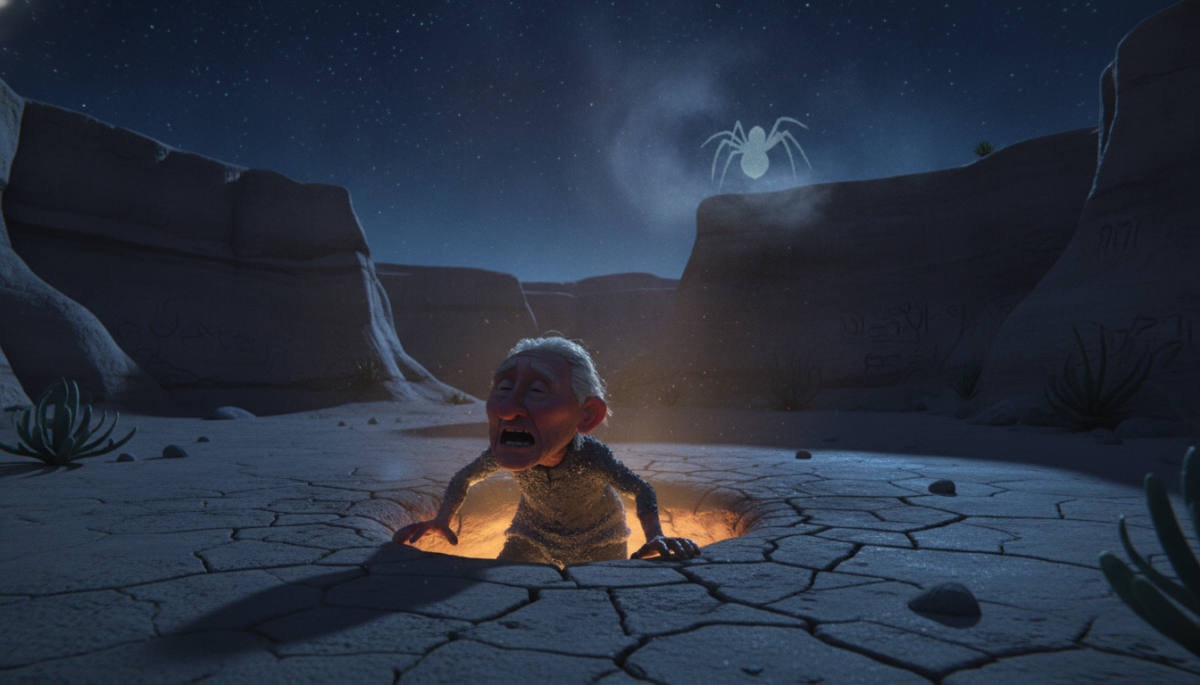
And then, a sudden, sharp shock. My head broke through the surface of the Sipapu. The air of this Fourth World, Tuwaqachi, was not like the heavy, wet steam of the deep. It was sharp, cold, and thin. It cut my throat like a flint knife. I gasped, my lungs burning with the first taste of wind. My hands, caked in mud, clutched the cold, dry sand of the desert. We lay there on the earth like newborn mice, shivering, blind from the pale light of the stars and the cold silver of the moon. Spider Woman gathered us close, her touch surprisingly warm despite her spindly form. She did not offer us riches. Instead, she laid out ears of corn of different colors. The tall, beautiful yellow corn was claimed by the greedy, but we, the Hopi, chose the short, hard ear of blue corn. It was a symbol of ruggedness, humility, and a life of hard work. Spider Woman smiled, a sound like dry leaves rubbing together, knowing we had chosen the path of survival.
The Legacy of the Clay
Now, the fire is nearly dead, my child. The cold is creeping in from the edges of the dark, and my breath grows shallow. Remember this story when the dry winds howl across the mesa. We did not drop from the sky like eagles, nor did we rise from the sea like fish. We crawled out of the very belly of the earth, wet, shivering, and humble, saved only by a spider’s thread and a hollow reed. This land beneath your feet is not yours to conquer; it is the mother that birthed you through the Sipapu. When you walk upon the dry mesas, tread softly, for you are walking on the roof of your old home, and the dust on your feet is the dust of your ancestors. Keep the blue corn in your heart, and do not let the spark in this ash die.
Frequently Asked Questions
Why did the Hopi people have to abandon all of their material possessions before climbing the reed?
According to the story, leaving behind heavy clay pots, woven blankets, pride, and anger was essential for survival. The climb through the hollow reed was an arduous physical and spiritual journey where any extra weight—physical or emotional—would cause a person to lose their grip and fall into the drowning void of the Third World below.
What is the physical significance of the Sipapu in the Hopi emergence story?
The Sipapu represents the earth's birth canal, a narrow, wet crack in the stone. Crawling through it was a painful, physical shedding of the old self. Emerging from this tight space caked in mud and gasping for air symbolizes a literal rebirth, transitioning the Hopi from the dark, ruined Third World into the cold reality of the Fourth World.
How does the air of the Fourth World differ from that of the Third World?
While the Third World's air was a thick, wet steam smelling of stagnation and rot, the air of the Fourth World, Tuwaqachi, is described as sharp, cold, and thin. For the emerging Hopi, breathing this new air for the first time was a shocking experience that felt like a flint knife cutting the throat.
What role does Spider Woman play in the Hopi transition between the worlds?
Spider Woman, or Kokyangwuti, acts as a spiritual guide rather than a physical savior. She hears the prayers of the untainted, plants the hollow reed, and guides the climbers with a rhythmic tapping. At the Sipapu, she instructs them to crawl through naked, welcoming them into the Fourth World with warmth and protection.
Discover more from Nenext
Subscribe to get the latest posts sent to your email.