

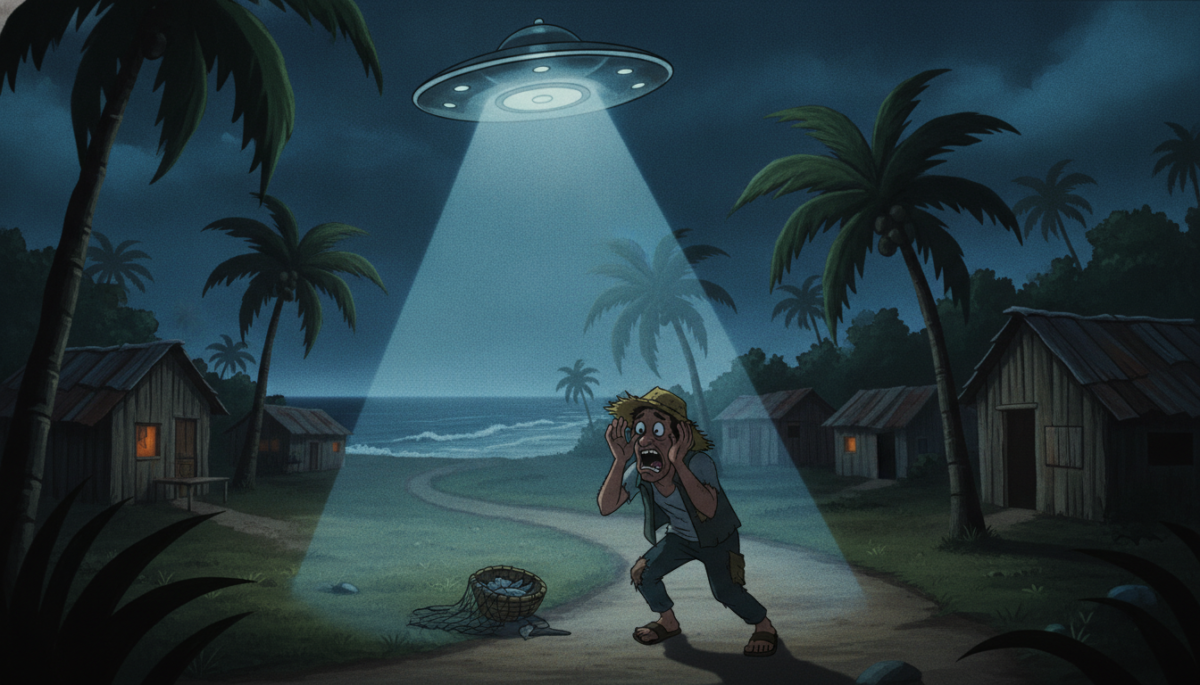



The salt air of Colares Island usually carried the scent of roasting fish and damp earth. But in the dry season of 1977, a metallic tang of ozone hung over this remote Brazilian fishing community. Nestled in the mouth of the Amazon River, Colares was a place where life moved to the slow rhythm of the tides. That rhythm was violently shattered when the sky itself turned hostile. It began with silent, glowing spheres drifting over the canopy, but soon, these aerial anomalies began to hunt.
Locals called the phenomenon Chupa-Chupa—the “sucker-sucker.” It was not an abstract threat. For the fishermen and farmers of Colares, the terror was physical, searing, and deeply personal. People were not just seeing lights; they were being targeted by them.
The Night the Sky Bled Light
Imagine standing on a dark, unlit street, the canopy of the Amazon jungle whispering in the breeze, when a silent, metallic cylinder the size of a bus hovers overhead. From its underbelly, a concentrated beam of green or red light shoots downward, piercing the thatched roof of your home. This was the nightmare experienced by hundreds of residents. The light did not just illuminate; it burned, paralyzed, and seemed to drain the very life from its victims.
Newton Cardoso, a local resident, recalled the sheer panic of those months. “Nobody slept. If you slept, the light would get you,” he later recounted. Families huddled together in small rooms, lighting bonfires on the beaches and banging pots to scare away the intruders. The air was thick with the scent of burning flesh and the desperate prayers of a community under siege. The light beams left victims with strange, localized burns resembling radiation injuries, accompanied by two distinct puncture wounds at the center of the wound—as if their blood had been systematically sampled.
Dr. Carvalho’s Grim Discoveries
At the local clinic, a young, skeptical physician named Dr. Wellaide Cecim Carvalho found herself thrust into a sci-fi horror film. Day after day, terrified citizens flooded her waiting room. They weren’t suffering from mass hysteria; their physical symptoms were undeniably real. Dr. Carvalho treated dozens of patients presenting with first- and second-degree burns, acute radiation sickness, severe hair loss, and profound anemia.
“The victims always presented with a drop in red blood cells,” Dr. Carvalho later revealed in interviews. “They had puncture marks that looked like syringe needles, and the skin around the wounds would turn black within days.” Despite pressure from her superiors to diagnose the patients with simple psychological distress, Dr. Carvalho refused to lie. She knew that whatever was hunting the people of Colares was using a technology that defied medical understanding, leaving its victims physically depleted and psychologically scarred.
Operation Saucer: The Military Steps In
As the panic threatened to depopulate the island, the Brazilian Air Force intervened, launching a highly classified investigation codenamed Operação Prato (Operation Saucer). Led by the pragmatic and highly decorated Captain Uyrangê de Hollanda, a team of military officers arrived in Colares equipped with state-of-the-art cameras, motion sensors, and radiation detectors.
Captain Hollanda initially believed he was sent to debunk a case of collective delusion or perhaps investigate clandestine foreign drone activity. Instead, the military team walked directly into the anomalous crosshairs. Over several months, Hollanda and his men took thousands of photographs and recorded hours of film footage depicting glowing discs, cigar-shaped crafts, and luminous spheres performing maneuvers that defied the laws of physics. They watched as these objects emerged from the depths of the ocean and vanished into the stratosphere at incomprehensible speeds. The hunters had become the observed, and the military was utterly powerless to stop them.
The Captain’s Final Confession
Then, just as the investigation was yielding its most compelling evidence, the Brazilian military abruptly shut down Operation Saucer. The files were classified, the photographs locked away in high-security vaults, and the officers were ordered to stay silent. For twenty years, Captain Hollanda carried the weight of what he had witnessed in the Amazonian skies.
In 1997, unable to bear the silence any longer, Hollanda gave a bombshell interview to prominent Brazilian UFO researchers. He detailed his close encounters, describing beings that stood over two meters tall inside the crafts and confirming that the military had documented undeniable proof of extraterrestrial technology. He spoke with the haunting intensity of a man who had looked into the abyss. Just a few weeks after his confession, Captain Hollanda was found dead in his home, having apparently committed suicide. The timing of his death cast a dark, conspiratorial shadow over the Colares legacy, leaving the world to wonder what final, terrifying truth he had taken to his grave.
Today, Colares has returned to its quiet rhythms, but the scars of 1977 remain etched in the memories of those who survived. The dark Amazonian sky, once a canopy of comforting stars, remains a source of quiet anxiety for the islanders. They know that sometimes, the things that go bump in the night do not hide in the shadows—they cast a burning, brilliant light from above.
Frequently Asked Questions
Por que o fenômeno de Colares recebeu o nome peculiar de Chupa-Chupa?
O termo Chupa-Chupa foi cunhado pelos próprios moradores de Colares porque as vítimas dos feixes de luz apresentavam sintomas severos de anemia, perda de hemácias e marcas de furos na pele semelhantes a picadas de agulha. A população local sentia que os objetos misteriosos estavam literalmente sugando o sangue e a energia vital de seus corpos.
Quais foram as evidências físicas e médicas reais deixadas nas vítimas dos ataques?
A médica Dra. Wellaide Carvalho documentou queimaduras de primeiro e segundo graus parecidas com lesões por radiação, queda de cabelo acentuada e necrose da pele ao redor de duas marcas de punção centrais. Exames clínicos também comprovaram uma queda drástica e inexplicável na contagem de glóbulos vermelhos dos pacientes afetados.
Como a comunidade de Colares tentava se proteger contra as investidas das luzes?
Tomados pelo pânico e pela privação de sono, os moradores de Colares adotaram táticas defensivas coletivas. Eles se reuniam em grupos dentro de cômodos pequenos, acendiam fogueiras nas praias durante a noite e batiam panelas constantemente, na esperança de que o barulho e o fogo pudessem afugentar os objetos invasores.
Qual era o objetivo inicial da Operação Prato e o que os militares realmente encontraram?
A Força Aérea Brasileira enviou a equipe do Capitão Hollanda para desmistificar o histerismo coletivo ou flagrar espionagem estrangeira. Contudo, os militares registraram milhares de fotos e filmagens de discos e esferas luminosas saindo do oceano e realizando manobras impossíveis, tornando-se testemunhas oculares do próprio fenômeno que deveriam refutar.
Discover more from Nenext
Subscribe to get the latest posts sent to your email.